

Diamond Blade
A diamond blade is a saw blade which has diamonds fixed on its edge for cutting hard or abrasive materials. There are many types of diamond blade, and they have many uses, including cutting stone, concrete, asphalt, bricks, coal balls, glass, and ceramics in the construction industry; cutting semiconductor materials in the semiconductor industry; and cutting gemstones, including diamonds, in the gem industry. A diamond blade is composed of a core or body of high precision steel with a mix of metal powder, diamond segments, and a resin bond that keeps it all together. The sizes and thus the hardness of the diamonds is designed with different concentrations, depending on the kind of blade, or in other words, depending on the material that it will cut.
Advantages of Diamond Blade
Speed
Speed is important in any concrete cutting project. The faster you finish the cutting, the better your chances of earning more money are in the process. Turbo blades come with a continuous outer rim with a serrated edge which helps the blade withstand high speeds while still being precise. You can expect a high-quality performance from a diamond blade due to this feature.
Durability
Diamond blades are extremely durable compared to other types of concrete cutting blades on the market. The diamond blade is made using a circular steel disk with segments on the outer edge.These segments are made from a combination of diamonds and metal bond powder. They are fused under high pressure and heat.
Precise and smooth cutting
Diamond blades have a high level of precision compared to other concrete cutting blades. The low vibration is one factor that contributes to the precision of the blade.The cutter can position the blade a lot more precisely without causing a mess. Diamond blades are also ideal for smoother cuts.
Comfortable to use
Cutting concrete with a diamond blade results in cuts with far less chipping and breakages. The blade will produce less noise compared to other types of cutting blades.
-
 Diamond Blade for Granite Basalt CuttingUsing silver high frequency welding to braze the segments on the steel cores.. Smooth cutting, fast cutting speed, long diamond life.. Wet cutting saw blades..Add to Inquiry
 -
 Diamond Saw for Marble CuttingJDK Diamond Saw Blade for Marble edge cutting are designed particularly for cutting through marble slab. These blade can also be used for cutting soft masonry materials like limestone, travertine,Add to Inquiry
 -
 Diamond Blade for Concrete CuttingVarious bond for hard and non-abrasive materials.. Safe, High efficiency & Durable.. Wet Use..Add to Inquiry
 -
 Diamond Blade for Asphalt CuttingThis asphalt diamond cutting disc can effectively cut soft, abrasive materials such as asphalt and green concrete, application options include wet and dry, widely used for cutting asphaltAdd to Inquiry
 -
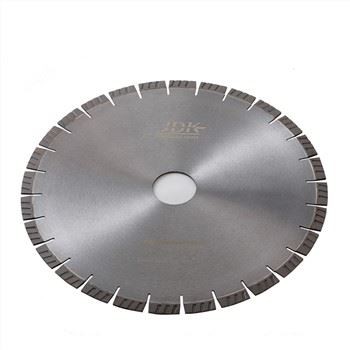 Turbo Segmented Diamond BladeExcellent comprehensive cutting performance.. This design of segment allows ideal debris removal and better cooling.. This segment improves the sharpness and cutting efficiency..Add to Inquiry
 -
 T Segment Diamond Saw BladeThe design of segment allows ideal debris removal and better cooling.. Higher cutting efficiency than general segment blade..Add to Inquiry
 -
 Fish Hook Diamond BladeGood continuity,effectively reduce the distance between teeth,cutting edge does not collapse.. The blade has good sharpness and high efficiency at the process of cutting..Add to Inquiry
 -
 Super Thin Turbo Diamond DiscNarrow turbo design offers a faster, cleaner and more accurate cuts.. 10mm rim height for extended cutting life.. Cooling holes allow air to cool down the blade quickly and effectively..Add to Inquiry
 -
 Segmented Diamond Disc Dry CuttingWidely use for cutting and grinding, including granite, concrete, sandstone, ect. A great quantity of exclusive formula for all kinds of different stone. long lifespan,good sharpness,stableAdd to Inquiry
 -
 Convex T Slot Diamond DiscBoth wet and dry cutting.. Competitive price, quick and smooth cutting.. Arbor: 22.23-20mm or 16mm to fit all saws; M14 or 5/8-11 flange..Add to Inquiry
 -
 Protection Teeth Diamond Disc 5 InchCutting hard granite, marble, engineered stone and ceramic tile.. Sharp & Durable.. Both wet and dry cutting..Add to Inquiry
 -
 Customized Diamond DiscSharp & Durable.. Both wet and dry cutting.. Two side working.Add to Inquiry


- Tel: +86-595-22892387
- Fax: +86-595-22892397
- diamondtools@jdktools.com
- Add: 11#, Jinxi 6th Rd., Binjiang Industrial Zone, Xiamei, Nan'an, Fujian, China
Why Choose Us
Our product
Diamond segment, diamond tools, diamond blade, diamond fickert, diamond wire, diamond polishing pads, diamond core bits, diamond cup wheels, etc.
Rich experience
We have 20 years experience, JDK has been engaged in manufacturing and exporting worldwide quality diamond tools since 1995.
MR&D
With a professional R&D team of more than 10 people. The development of advanced test equipment for R & D team plays a role as powerful hose in constantly developing new products and maintain technological leadership.
Quality control
JDK build a scrupulous and diligent study of the quality assurance team, not only ensuring the quality of raw materials and finished products, as well as strict monitoring process to ensure product quality at all times under the management of the company strictly.

Diamond crystals
The diamond crystals that manufacturers attach to these blades are typically synthetic and come in a wide range of sizes, shapes, and types. These diamond varieties influence the type of cut and performance of the blade.
Diamond edge and metal bond
A metal bond adheres the diamond crystals to the edge of the blade. This bond is formed by a mixture of different metals. During the grinding process, this bond slowly exposes the diamond particles to result in a clean cut. The harder the metal bond, the smaller the diamond erosion, and vice versa. Softer metal bonds are ideal for cutting harder materials because of the stronger diamond erosion. Meanwhile, harder bonds are ideal for cutting softer materials due to the less aggressive diamond erosion.
Steel core
The steel core of the diamond blade is perfectly centered to allow the blade to turn. The steel core helps reduce stress on the blade through the tensioning process during manufacturing.
The core is typically a round flat metal disc used to support the outer segments. The diamond can be attached to the core using vacuum brazing, sintering, or laser welding. The process level used to manufacture the core is related to the attachment methods. Lower cost, higher volume blades use either a vacuum brazed or sintered attachment process. Vacuum brazed and sintered blades are intended for dry cutting soft material on low horsepower equipment. The cores used for these blades are typically very simple and do not undergo many of the steps of the blades for more aggressive applications.
Of the three most common forms of attaching the segments to the core, and by far the method that yields the strongest bond to the core, is laser welding. The more aggressive applications for diamond blades involve the use of higher horsepower equipment wet cutting harder materials to much greater cut depths. The steel cores for these aggressive applications are thicker, heat-treated, precision-ground, and tensioned. The additional thickness and heat treatment allows the core to withstand the flexing stress of the heavier equipment and higher horsepower. The precision grind on the surface minimizes the drag while the tensioning establishes the flatness of the blade at a specific rpm range.
The diamond used is manufactured or synthetic as opposed to natural. Manufactured diamond is preferred over natural diamond because key characteristics like crystal shape, size, and strength can be closely controlled through the manufacturing process. The ability to control the key characteristics of the synthetic diamond allow for accurate prediction of cutting speed and blade life as well as consistent repeatability. The amount of diamond in the segment is variable and requires more horsepower as the content of diamond is increased in the segment. Simply put it means that as more diamond is added to the segment more horsepower is needed to make the blade cut. In practical terms this means that blades for high horsepower saws will have more diamond in the segment.
The quality of the diamond determines the ability of the individual diamond to resist heat and maintain a sharp point. Better diamonds can hold a point longer at higher temperatures. Finally the last thing to consider is the size of the diamond. The individual’ s diamond sizes are specified in mesh ranges like 25-35 or 50-60. The higher the numbers the finer the individual particles. In practical application finer diamond is used for critically-hard material like chert or quartz while the larger more coarse diamond is used for soft materials like asphalt and soft red clay bricks. The bond is a mixture of metal powders used in various combinations to achieve specific wear rates. A correctly-formulated bond holds the diamond in place, just long enough to get maximum use from the diamond points before releasing the stone and exposing the next layer of diamond.
The wear rate for the segment can be simplified to the ability of a metal to resist wear from abrasion. Metals with low abrasion resistance like bronze are considered soft. The soft bonds are mostly made up of soft metals like Bronze and are common when cutting very hard less abrasive material like porcelain. The hard bonds are mostly made up of hard metals like tungsten carbide and are common when cutting very soft abrasive materials like asphalt or freshly poured concrete. The best way to remember bond-to-material application is ‘opposites attract’ - hard bonds for soft abrasive materials while soft bonds are used for hard less abrasive materials. In some extreme cases, it is possible to simply judge the hardness of the blade by noticing the color of the segment. Because soft blades contain a majority of Bronze, the soft blades for extremely hard materials will have a yellow tint to the segment.
Tips for Using Diamond Blades
Use protective gear
Before using your diamond blades, you need to get the correct protective equipment. Essential safety gear on construction sites consists of a blade guard, dust mask, protective eyewear, a helmet, ear defenders, work boots, safety gloves and high-visibility clothing.
Choose the right blade
Determine what material you’ re cutting and whether you want a rough or fine cut. Once you understand your specific application, choose a diamond blade that’ s right for the job.
Understand dry and wet cutting
Dry cutting with a blade that requires water can be dangerous, so it’ s essential to understand when you can cut materials dry. If in doubt, review the manufacturer’ s specification. Additionally, using a dry cutting technique can cause harmful to accumulate so make sure to always wear the correct mask protection.
Inspect and maintain your blades
Thoroughly inspect your saw and blades before you start to cut. When examining the blade, look for impairments such as cracks, chips, gouges, or missing tips. While it’ s normal to have some wear and tear, missing segments or damaged blades can slow down your work and become serious safety hazards.
Diamond blades don't really "cut" like a knife… they grind. During the manufacturing "break-in" (grinding) process, individual diamond crystals are exposed on the outside edge and sides of the diamond segments or rim. These exposed surface diamonds do the grinding work. The metal "matrix" locks each diamond in place. Trailing behind each exposed diamond is a "bond tail" (also called "comet tail"), which helps support the diamond. While the blade rotates on the arbor shaft of the saw, the operator pushes the blade into the material. The blade begins to cut through the material, while the material begins wearing away the blade.
Exposed, surface diamonds score the material, grinding it into a fine powder. Embedded diamonds remain beneath the surface. Exposed diamonds crack or fracture as they cut, breaking down into even smaller pieces. Hard, dense materials cause the diamonds to fracture even faster. The material also begins to wear away the metal matrix through abrasion. Highly abrasive materials will cause the matrix to wear faster. This continuous grinding and wearing process continues until the blade is "worn out". Sometimes, small unusable parts of the segments or rim may remain. It is important to understand that the diamond blade and the material must work together (or interact) for the blade to cut effectively.
For a diamond blade to work properly, the diamond type, quality, and grit size must be suited for the saw and the material. The metal matrix must also be "matched" to the material. Blades for cutting hard, dense (less abrasive) materials (tile, hard brick, stone, hard-cured concrete) require a softer metal matrix. The softer metal matrix wears faster, replacing worn-out diamonds fast enough for the blade to keep cutting. Blades for cutting soft, abrasive materials (block, green concrete, asphalt) must have a hard metal matrix to resist abrasion and "hold" the diamonds longer.

Factors involving concrete
When cutting concrete, several factors influence your choice of diamond blades. These include compressive strength, hardness of the aggregate, size of the aggregate, type of sand, steel reinforcing and green or cured concrete.
Compressive strength
Concrete slabs may vary greatly in compressive strength, measured in pounds per square inch (psi). Most concrete roads are 4-6,000 psi, while typical patios or sidewalks are about 3,000 psi.
Hardness of aggregate
There are many different types of rock used as aggregate. Hardness often varies even within the same classification of rock. For example, granite varies in hardness and friability.
Size of the aggregate
The size of the aggregate affects diamond blade performance. Large aggregates tend to make a blade cut slower. Smaller aggregates tend to make a blade cut faster.
Type of sand
Sand is part of the aggregate mix, and determines the abrasiveness of concrete. "small aggregate" is usually sand. Sand can either be sharp (abrasive) or round (non-abrasive). To determine the sharpness of sand, you need to know where the sand is from. Crushed sand and bank sand are usually sharp; river sand is usually round. Green concrete is more abrasive than cured concrete. When the concrete is not fully cured sand can more easily be scraped off the surface being cut. More loose sand means more abrasiveness.
Amount of steel reinforcing (rebar)
Heavy steel reinforcing tends to make a blade cut slower, while less reinforcing tends to make a blade cut faster. "light" to "heavy" rebar is a very subjective term.
Green or cured concrete
The drying or curing time of concrete greatly affects how the material will interact with a diamond blade. Green concrete is freshly poured and has set up, but is not yet fully cured. It is softer and more abrasive than cured concrete. You need a harder bonded blade with undercut protectors to cut green concrete. You need a softer bonded blade to cut the same concrete in a cured state.
Different Types of Diamond Blades
Segmented
This is the most common type of diamond blade and has individual segments which are separated by gullets and will be available in different depths as mentioned. These will give the roughest cut and are best for concrete, brick and masonry.
Turbo rim
This rim is specifically designed to cut faster in either wet or dry applications. The blade is able to cut faster due to the design of the turbo segments; it effectively cuts things such as concrete, brick and limestone.
Continuous rim
This type of blade is often referred to as a wet cut blade. Using water when cutting material allows for the water to significantly cool the blade; this allows for a longer life and less friction in the cutting zone. This rim cuts the slowest but produces the best cut. It is generally used for marble, granite and ceramic tile.
Choosing the right diamond blade depends on what you’re using it for because they come in many sizes, performance levels, qualities, and prices. So, how do you choose the right one? Typically, you want to consider the following aspects. The first thing to look for is whether the blade can cut the materials you have. While most are compatible with diamond blades, some materials like asphalt and sandstone need specifically designed diamond blades.
Next, you’ll want a blade that won’t wear down quickly but also cuts at high speeds. Being able to cut quickly means you’ll get a precise line and reduce chipping, but this can also cause your saw to overheat and wear it down over time. If you can, go for a segmented wet blade rather than a dry one. This helps keep the blade cool, which increases its lifespan.
Lastly, one of the most important things to consider is whether it’s compatible with your saw. If your saw and blade aren’t matched, this can shorten the blade’s lifespan. Generally, your equipment will perform better if you match low-performance blades with low-horsepower saws, and high-performance blades with high-horsepower saws.
A diamond blade consists of synthetic diamond crystals that are bonded to the blade’s edge. These diamonds make clean “cuts” by grinding away at the surface of the material. It’s the best choice for almost every cutting job because it’s long-lasting, produces less heat, cuts precisely, and makes minimal noise.
FAQ
As one of the leading diamond blade manufacturers and suppliers in China, we warmly welcome you to wholesale durable diamond blade in stock here from our factory. All diamond tools are with high quality and competitive price. For quotation, contact us now.
