

PCD
PCD (Polycrystalline Diamond) has been used in the wood/composites industry for over years due to its abrasion resistant properties and hardness. Polycrystalline Diamond (PCD for short) is composed of diamond particles that are sintered with a metallic binder at extreme high temperatures and pressures, creating the hardest, and one of the most abrasion resistant materials used in cutting tools today. The cutting tool industry being only one of them, for use in the production of cutting tools. Tooling that utilizes this synthetic diamond material is now used in a wide range of machining applications including sawing, routing, drilling and profiling, to maximize tool life and reduce overall production cost.
Advantages of PCD
Resistance to abrasion
Almost all materials undergo wear and tear over time; this is all the more true in the case of tools used for cutting and drilling as they experience the highest amount of friction on a regular basis. Hence, tools are generally manufactured using those materials which offer the highest abrasion resistance, thus delaying the wear and tear of the tools.
High tenacity
One of the most unique advantages of polycrystalline diamond tools is that they show amazing tenacity even on hard surfaces and objects which indicates their high stability. Hence, PCD tools are widely used for cutting or drilling surfaces when high precision and accuracy is required.
Hardness
The natural diamond particles used in manufacturing polycrystalline diamond obviously impart hardness to the material and, hence, to the tools manufactured using PCD. This hardness makes them perfect for cutting or drilling metals and metal alloys such as aluminum, copper, steel, titanium, platinum, and other materials including graphite, ceramic, rubber, etc.
High heat conductivity
Diamonds have one of the highest heat conductivity coefficients in any of the naturally occurring materials; this property of diamonds increases the heat conductivity of PCD tools also. High heat conductivity allows the tools to transfer heat from the heat source to the heat sink efficiently, thereby keeping the equipment or tools cool even after long use.
-
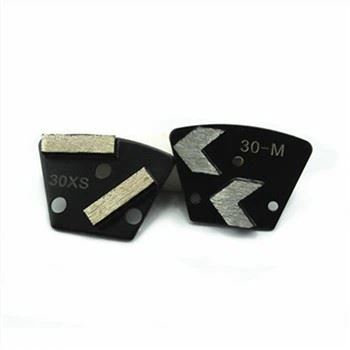 Diamond Trapezoid Grinding PlatesSegment types can be different as your demand.. For use on medium to large machines.. Rounded segments make the processing to be evenly..Add to Inquiry
 -
 PCD Trapezoid Grinding PlatesCoatings removal/demolition. . Floor preparation. . High production..Add to Inquiry
 -
 PCD Grinding Cup WheelsUses polycrystaline diamond (PCD) tips for performance and durability.. Generous PCD tip count for rapid action and longer life..Add to Inquiry
 -
 Diamond Grinding Cup Wheels for ConcreteLong diamond segments help achieve smooth results.. Open lay-out resists loading.. Can be used wet or dry..Add to Inquiry
 -
 Diamond Grinding Disc for ConcreteChecking your size: The 4 inner holes are on a square of 48mm side. (Your machine may need the correct adaptor plate.)Add to Inquiry
 -
 Resin Diamond Grinding Disc for ConcreteWith velcro attachment, easy to operate.. Fast polishing and long life.. Best choice for concrete polishing..Add to Inquiry


- Tel: +86-595-22892387
- Fax: +86-595-22892397
- diamondtools@jdktools.com
- Add: 11#, Jinxi 6th Rd., Binjiang Industrial Zone, Xiamei, Nan'an, Fujian, China
Why Choose Us
Our product
Diamond segment, diamond tools, diamond blade, diamond fickert, diamond wire, diamond polishing pads, diamond core bits, diamond cup wheels, etc.
Rich experience
We have 20 years experience, JDK has been engaged in manufacturing and exporting worldwide quality diamond tools since 1995.
MR&D
With a professional R&D team of more than 10 people. The development of advanced test equipment for R & D team plays a role as powerful hose in constantly developing new products and maintain technological leadership.
Quality control
JDK build a scrupulous and diligent study of the quality assurance team, not only ensuring the quality of raw materials and finished products, as well as strict monitoring process to ensure product quality at all times under the management of the company strictly.
During the ultra-high temperature and high pressure sintering process, when the temperature rises to about 800°C, as the cobalt atoms in the WC-Co layer start to diffuse toward the diamond, the diffused cobalt atoms interact with the carbon atoms on the diamond surface, causing the graphitization of the diamond surface near the WC-Co surface. The graphitization of the diamond surface, on the one hand, is beneficial to the relative sliding of diamond powder and the densification of diamond particles by rearrangement; on the other hand, it is beneficial to the subsequent diffusion penetration of cobalt-carbon eutectic solution between diamond particles. The sintering temperature rises to the cobalt-carbon eutectic point (1336°C), forming the cobalt-carbon eutectic liquid, which penetrates into the diamond layer under the ultra-high pressure force and capillary force. In the process of penetration, on the one hand, the graphitized carbon on the diamond surface is dissolved, on the other hand, due to the good wettability of cobalt liquid and diamond, the interaction between cobalt liquid and carbon atoms on the diamond surface is strong, so that the diamond particle surface, which is still at low pressure, is rapidly graphitized, and at this time, the diamond particles are rearranged once again under the action of cobalt liquid; after the sintering system enters the stable zone of diamond, graphite is wettable by cobalt liquid and forms interstitial solid melt or CoxC interstitial phase. The carbon atoms in the cobalt melt diffuse toward the WC-Co interface under the combined effect of concentration and temperature gradient, and during the diffusion process, different atoms or atomic groups further interact with each other to form carbon atoms or atomic groups with sp3 structure.
In the diamond-Co liquid sintering system, the diamond-graphite transition is a reversible phase transition process, and its phase transition chance and phase transition degree are closely related to the phase transition driving force △p. In the region far from the WC-Co interface, the pressure is low and the temperature is high, and the G--D phase transition driving force is small; in the region near the WC-Co interface, the pressure is high and the temperature is low, and the G--D phase transition driving force is large, which is more favorable to the occurrence of the G--D process and the precrystallization process can be carried out more stably. region, so that the cobalt melt in this region is supersaturated with carbon atoms of sp3 structure continuously precipitated. These sp3 atoms can be grown by adsorption on the original diamond surface or by deposition on the recrystallized diamond surface with three-dimensional nucleation. When the carbon concentration in the cobalt melt between the growth surfaces exceeds the critical concentration of carbon, the solid-liquid interfacial energy between the diamond-cobalt liquid will be greater than the solid-solid interfacial energy between the diamond grains, and the cobalt melt between the grains will be squeezed out of the grain gap, bringing the growth surfaces into direct contact. Thus, the direct diamond-diamond bonding is realized and the polycrystalline diamond structure is formed.
How to Use PCD
Machining aluminum workpieces with PCD diamond tools has the advantages of long tool life and high metal removal rate, but the disadvantage is that the tools are expensive and the machining cost is high. This point has formed a consensus in the machinery manufacturing industry. However, the development and application of PCD tools have undergone many changes in recent years. Another change of PCD tools is the continuous reduction of processing costs, in the market competition pressure and tool manufacturing process improvement Under the combined effect of competitive market pressure and tool manufacturing process improvement, the price of PCD tools has dropped significantly by more than 50 percent. These trends have led to an increase in the use of PCD tools in the machining of aluminum materials, while the applicability of the tools is governed by the different materials being machined.
We recommend the use of fine grain (or medium grain) PCD grade to process non-silicon and low-silicon aluminum alloy materials. Coarse grain PCD grade is used to process high silicon aluminum alloy material. If the surface finish of the workpiece processed by milling does not meet the requirements, the surface of the workpiece can be trimmed by using a trimmer insert with a smaller grain size to obtain a satisfactory surface finish.
The correct application of diamond inserts is a prerequisite to obtain satisfactory processing results. Although the specific causes of tool failure vary, they are usually due to incorrect use of the object or method of use. When ordering PCD inserts, the user should correctly grasp the tool’ s range of adaptation. For example, when processing ferrous metal workpiece (such as stainless steel) with PCD inserts, as the diamond is very easy to chemical reaction with the carbon in the steel, will lead to rapid wear of PCD inserts, therefore, the correct choice for processing hardened steel should be PCBN inserts.
Generally speaking, in order to reduce the cutting force and prevent the generation of chip tumor, PCD inserts should use positive cutting angle. But in the processing of high silicon aluminum alloy (especially in the use of diamond inserts instead of carbide tools for processing), the PCD insert back angle is best than the original carbide tools used back angle (such as 250) slightly reduced, in order to improve the PCD insert cutting edge on high silicon aluminum alloy cutting performance. PCD insert positive front angle is also not too large, because the larger the tool front angle, the lower the cutting edge strength, in other words The smaller the back angle of the PCD insert, the higher the strength of the cutting edge. In order to increase the cutting edge strength as much as possible under the premise of guaranteeing the positive cutting angle of the tool, we welded the CNMX insert with negative front angle to the tip of the PCD tool and formed a positive cutting angle, so that the negative front angle of the insert provides a high cutting edge strength without affecting the normal cutting of the tool. When preparing the cutting edge of PCD inserts, it is not necessary to make too much process for the diamond tip. For PCD milling cutters, the cutting edge can be lightly sharpened, in addition, making the cutting edge produce a certain axial inclination also helps to improve the cutting performance of PCD tools.
Grinding
In view of high hardness and wear resistance of polycrystalline diamond, the grinding ways mainly are diamond grinding wheel grinding, electric discharge grinding and electrochemical grinding. Diamond wheel grinding is the simplest and most effective grinding method. In the actual machining process, apply to different grinding methods to combine machining.
Diamond wheel grinding
When diamond wheel grinding polycrystalline diamond, the direct contact pressure and grinding pressure between the grinding wheel and workpiece are high, so it requires the grinding system has sufficient rigidity and high precision. In the early stage of development resin bond diamond grinding wheels are used, but the grinding efficiency is low. In recent years, with the development of the technology of vitrified bond diamond grinding wheel, its comprehensive performance far exceeds resin bond grinding wheel. Therefore, many vitrified bonded diamond grinding wheels for PCD and PCBN have been applied, replacing most of the resin bond diamond grinding wheels.
Mirror grinding of polycrystalline diamond
Its basic principle is that use the dynamic balance between the non-linear electrolytic dressing and the electrolytic inhibition of the oxide insulating layer on the surface of the metal bond superhard grinding wheel to dress the grinding wheel continuously. So the grinding wheel can obtain constant outburst. And it can be continuously processed in the optimum grinding state. It is suitable for the precision mirror of hard and brittle materials.
Electrical discharge grinding(EDG)
In the process of EDM, the characteristics of the pulse are very important, especially in the processing of PCD materials. PCD has a certain conductivity, good thermal conductivity, and high melting point, so it is very difficult to process polycrystalline diamond by traditional EDM. The erosion mechanism of electric discharge grinding for PCD includes gasification of diamond, oxidation of diamond, graphite and amorphous carbon conversion of diamond, throwing force by electric discharge, cracks generated by thermal stress on diamond surface and fracture and breakage of diamond grain. The graphitization of diamond plays a key role in the process of electric discharge polishing diamond film. It not only conducts electricity and maintains the discharge channels. And it makes a diamond film can be gasified at the top of prominent peaks. With the graphitization-oxidation process of diamond going, the diamond can be eroded. Electrical discharge grinding of polycrystalline diamond is an efficient and low-cost method, but it cannot effectively process large areas of polycrystalline diamond.
Lapping
There are three main lapping methods for polycrystalline diamond: one is precise grinding with diamond grinding wheel; one is grinding with a quenched high hardness steel plate (or agate plate) without any abrasive; the other is grinding with high speed rotating cast iron plate, supplemented by diamond powder. The lapping process can be used as a finish polishing process of polycrystalline diamond, and it is an important part of manufacturing polycrystalline diamond tools.
Lapping of diamond wheels
The lapping of PCD with a diamond grinding wheel is similar to that of grinding with a grinding wheel. But choose a different type of grinding wheel. The vitrified bond diamond grinding wheel is usually used for rough grinding. If the surface finish is required to be higher, fine resin bond grinding wheel can be used for grinding. When grinding polycrystalline diamond with diamond grinding wheels, because the process of diamond abrasive grain lapping the PCD materials is that two kinds of hardness and similar objects interact each other, and is essentially different from the traditional grinding process. Therefore, the PCD lapping mechanism and lapping process have their own features.
High-speed steel disc for polycrystalline diamond
The basic principle is friction occurs between PCD workpiece under certain pressure and high speed rotating high-speed steel disc, resulting in friction heat, which increases the temperature of grinding surface. The high temperature on the grinding surface is good for oxidation, graphitization, diffusion, bonding and thermal stress breaking of diamond grains on the grinding surface in PCD.

Applications of PCD
Automobile industry
PCD account for 60% of the applications in the automotive field. PCD are mainly used to process engine piston, pinhole, cylinder block, gearbox, carburetor and etc.. Because the silicon content of these parts is high (more than 10%) and most of them are produced in batches by pipeline mode and require high service life of the tools. And tungsten carbide tools cannot work. The durability of diamond tools is 10-50 times that of carbide tools. It can ensure the dimensional stability of the parts and improve the cutting speed, efficiency and surface quality of the workpiece
Wood processing industry
Recently, the wood-based panels widely used are obviously different from traditional wood. In a sense, synthetic panels are the concept of synthetic resin, but the process is different from traditional wood. In particular, the development of wood-based panels such as medium density fiberboard, plywood, particleboard, and composite flooring has accelerated the need for superhard cutting tools. Diamond cutting tools have gradually replaced the traditional woodworking tools in the market. The AL2O3 on the outermost layer of reinforced composite flooring greatly affects the wear of carbide tools.
Electronic industry
Usually, the cutting tool easily rolls up when cutting the edge of the printed board, which affects the installation and positioning of various electrical components, and the whole printed board is not beautiful. The carbide tool has a short service life, slow speed, low efficiency and poor accuracy in the processing of electrical printed boards. PCD multi-edged electric printing plate cutter does not wear easily, and the speed is up to 1500-2000M/S. Therefore, it has high efficiency and low cost and has been widely used.
Petroleum geological drilling industry
Polycrystalline diamond geological drill bits can achieve high footage(4-6 times higher than cone bits) and high drilling speed(2 times higher than core bits) at low bit pressure( about 40KN). It has higher safety than core bit, and can greatly improve drilling efficiency and reduce drilling costs. PCD drill bits have outstanding advantages in large soft to medium hardness formations, especially in high-cost offshore drilling, ultra-deep drilling, and slim hole drilling.

Cleaning
The dies should be cleaned regularly to remove any dirt, debris, or residue that may accumulate on the surface. This can be done using a soft-bristled brush and a cleaning solution that is specifically designed for diamond materials.
Inspection
Regular inspection of the dies is necessary to identify any signs of wear or damage that may affect their performance. The dies should be inspected for cracks, chips, or other signs of wear, and any issues should be addressed promptly.
Reconditioning
PCD dies may need to be reconditioned periodically to restore their surface finish and ensure proper performance. This process involves removing a thin layer of material from the surface of the die to expose fresh diamond grains.
Lubrication
Proper lubrication is important to reduce wear and friction on the dies during use. The type of lubricant used will depend on the specific application and should be chosen carefully to avoid any contamination or damage to the diamond surface.
Storage
Proper storage is essential to protect the PCD dies from damage when they are not in use. The dies should be stored in a clean, dry environment and protected from exposure to extreme temperatures or humidity.
FAQ
As one of the leading PCD manufacturers and suppliers in China, we warmly welcome you to wholesale durable PCD in stock here from our factory. All diamond tools are with high quality and competitive price. For quotation, contact us now.
